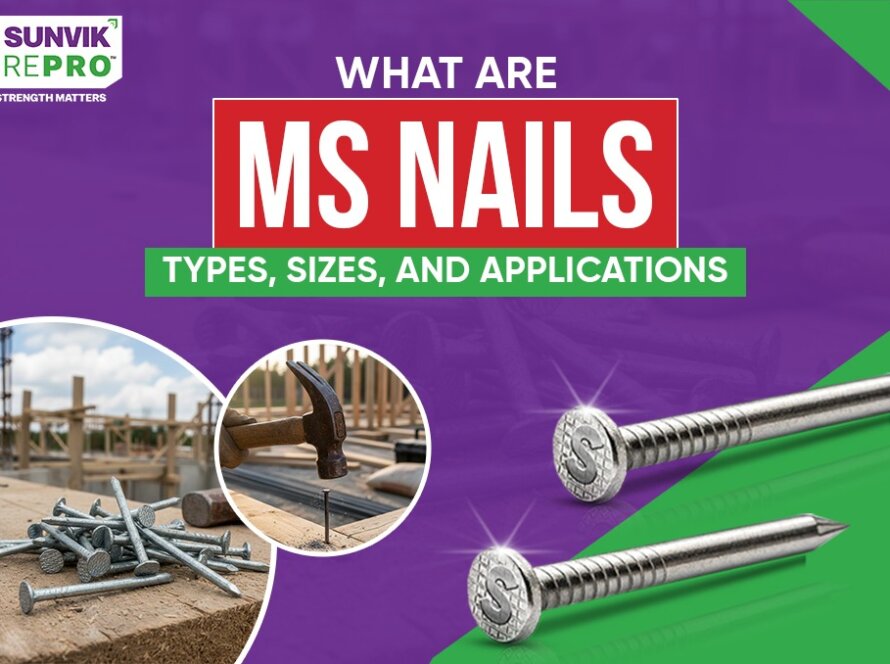
Manufacturing Process of High-Quality MS Nails
At first glance, an MS nail looks like one of the simplest products in the construction world. Small, straight, pointed — nothing complicated. But in reality, manufacturing high-quality Mild Steel (MS) nails requires precision engineering, strict material control, and carefully monitored production stages.
From residential buildings to large-scale infrastructure, from wooden furniture to heavy packaging crates, MS nails are everywhere. Their reliability directly affects structural strength, safety, and durability.
Let’s explore the complete manufacturing process in depth and understand what truly defines a high-quality MS nail.
Understanding Mild Steel: Why It’s Used for Nails
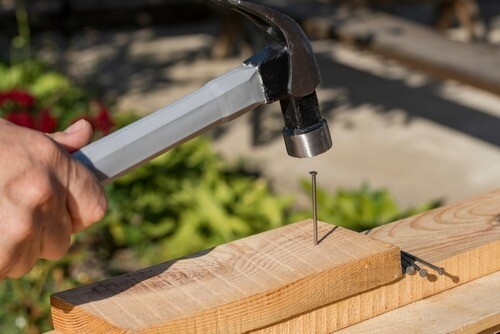
Mild steel contains a low percentage of carbon, typically between 0.05% and 0.25%. This gives it a perfect balance of:
- Strength
- Flexibility
- Toughness
- Workability
If carbon content is too high, nails become brittle and may snap during hammering. If too low, they may bend easily. That precise metallurgical balance is what makes mild steel ideal for nail production.
Additionally, mild steel offers:
- Good machinability
- Cost efficiency
- Easy heat treatment compatibility
- Recyclability
Step 1: Procurement and Inspection of Wire Rods
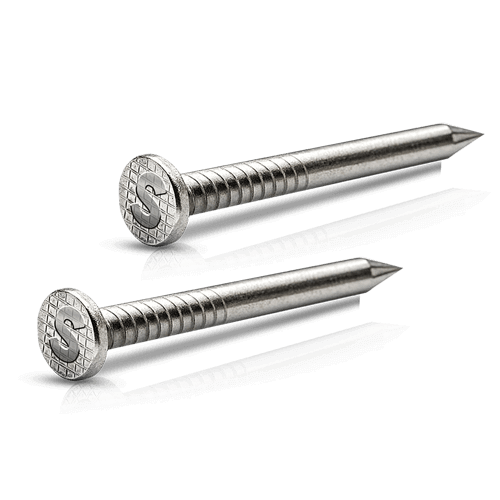
The manufacturing journey begins with mild steel wire rods, usually supplied in large coils weighing several hundred kilograms.
Before production starts, manufacturers perform quality checks such as:
- Chemical composition analysis
- Surface defect inspection
- Diameter consistency measurement
- Tensile strength testing
Any inconsistency in raw material directly affects final nail quality. High-grade raw material reduces rejection rates and improves production efficiency.
Step 2: Wire Drawing – Strength Through Reduction
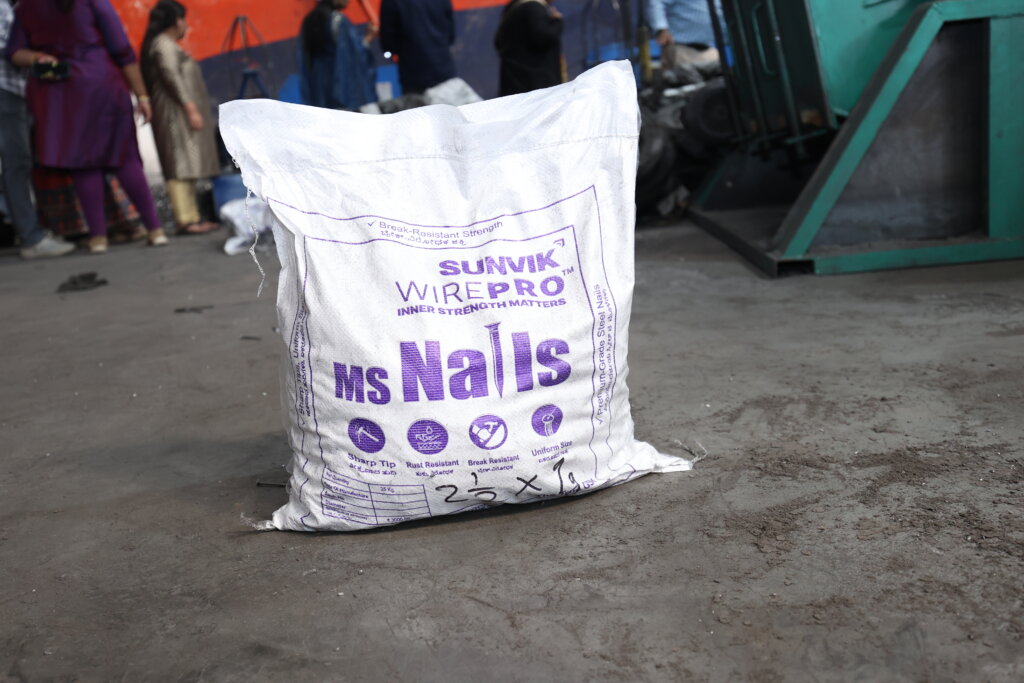
Wire drawing is one of the most critical steps.
The wire rod is pulled through a series of tungsten carbide or hardened steel dies. Each pass reduces the diameter slightly until the required size is achieved.
This process:
- Increases tensile strength through cold working
- Improves dimensional accuracy
- Enhances surface smoothness
- Eliminates minor surface irregularities
Lubrication plays an important role here. Specialized drawing lubricants reduce friction and prevent overheating, which could weaken the metal structure.
Modern wire drawing machines are equipped with speed control systems to maintain consistent tension, preventing micro-fractures.
Step 3: Nail Forming – High-Speed Precision Engineering
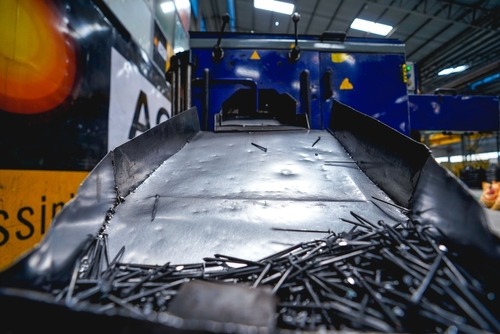
The drawn wire is fed into automatic nail-making machines.
A typical nail-making machine performs the following in a continuous cycle:
- Feeds the wire to a preset length
- Cuts the wire
- Forms the nail head
- Shapes the nail point
This entire cycle takes a fraction of a second.
Advanced machines can produce between 200 to 800 nails per minute depending on size. Larger industrial units use fully automated systems with minimal manual intervention.
Key precision factors at this stage include:
- Centered head formation
- Straight shank alignment
- Uniform length
- Sharp symmetrical point
Even slight misalignment can cause bending during hammering.
Step 4: Head Formation Mechanics
The nail head is created through a forging action. A mechanical hammer compresses one end of the wire under high pressure.
The pressure must be controlled accurately:
- Too much pressure can cause cracks.
- Too little pressure can create weak heads.
Head diameter varies depending on application. For example:
- Roofing nails require wider heads.
- Finishing nails have smaller heads for aesthetic purposes.
Step 5: Point Shaping and Tip Geometry
The nail tip is shaped by cutting dies at specific angles. The angle of the point determines how easily the nail penetrates material.
Common point types include:
- Diamond point
- Blunt point
- Chisel point
A well-shaped tip reduces splitting of wood and improves driving efficiency.
Step 6: Heat Treatment (When Required)
For heavy-duty nails such as concrete nails, heat treatment is essential.
The nails are placed in controlled furnaces where they are:
- Heated to a specific temperature
- Held for a set duration
- Quenched in oil or water
This increases hardness and wear resistance.
Heat treatment improves:
- Impact resistance
- Load-bearing strength
- Resistance to bending
However, improper heat treatment can make nails brittle, so temperature control is critical.
Step 7: Surface Polishing and Cleaning
After forming, nails often have minor burrs or rough surfaces.
They are placed inside a rotating polishing drum containing:
- Abrasive media
- Sawdust
- Sand
The tumbling process smooths edges and enhances surface finish.
Polishing improves:
- Handling safety
- Market appearance
- Coating adhesion (if galvanizing follows)
Step 8: Corrosion Protection and Coating Options
Plain MS nails can rust if exposed to moisture. To improve durability, manufacturers may apply:
Hot-Dip Galvanizing
Provides thick zinc coating for outdoor use.
Electro-Galvanizing
Gives thinner, uniform coating.
Phosphate Coating
Improves paint adhesion.
Oil Coating
Prevents temporary rust during storage.
Coating thickness determines service life. Nails used in coastal areas require heavier zinc coating.
Step 9: Quality Control and Mechanical Testing

Quality manufacturers conduct several tests:
Tensile Test
Measures maximum stress nail can withstand.
Hardness Test
Checks resistance to deformation.
Bend Test
Ensures flexibility without cracking.
Head Adhesion Test
Confirms head does not detach.
Dimensional Inspection
Ensures accurate length and diameter.
Sampling is done batch-wise to maintain consistent production standards.
Production Efficiency and Cost Factors
Several factors influence production cost:
- Steel price fluctuations
- Electricity consumption
- Machine efficiency
- Labor costs
- Coating materials
- Waste percentage
Advanced factories reduce scrap generation and recycle steel waste to improve profitability.
Automation also reduces human error and increases output consistency.
Environmental and Sustainability Aspects
Modern nail manufacturing plants focus on:
- Steel scrap recycling
- Energy-efficient furnaces
- Waste lubricant recycling
- Emission control systems
Since mild steel is fully recyclable, MS nails are considered environmentally sustainable products.
Common Defects in Low-Quality Nails
Low-quality nails may show:
- Crooked shank
- Off-center head
- Cracked head
- Blunt tip
- Uneven thickness
- Excessive rust
Such defects reduce holding power and increase material wastage on site.
Why Precision Matters in Construction
Though small, nails contribute to:
- Structural alignment
- Load distribution
- Long-term durability
- Safety
Poor-quality nails can cause loosening, structural instability, and repeated maintenance costs.
High-quality manufacturing ensures consistent performance in real-world conditions.
Frequently Asked Questions (FAQs)
- What makes MS nails strong?
Proper carbon balance, wire drawing precision, and heat treatment. - Can MS nails be used outdoors?
Yes, but galvanized nails are recommended for outdoor use. - How many nails can a machine produce per minute?
Modern machines can produce 200–800 nails per minute. - Why do some nails bend while hammering?
Low tensile strength or improper heat treatment. - Are MS nails suitable for concrete?
Special hardened concrete nails are required. - How long do galvanized nails last?
Depending on coating thickness, they can last many years even in harsh environments. - What is the standard size range?
Nails vary from small panel pins to large construction nails several inches long. - Can nails be customized?
Yes, manufacturers can adjust size, head type, and coating. - Is nail manufacturing automated?
Most modern factories use automated high-speed machinery. - Are MS nails recyclable?
Yes, they are fully recyclable as steel products.
Conclusion
The manufacturing process of high-quality MS nails involves far more than cutting steel into small pieces. It requires metallurgical precision, advanced machinery, strict quality checks, and careful finishing processes.
Every step — from wire drawing to heat treatment — contributes to the final strength, durability, and reliability of the nail.
Just like manufacturing requires precision and performance optimization, business growth also demands a strategic approach.
If you are a manufacturer, distributor, or industrial supplier looking to increase inquiries and generate qualified leads, paid advertising can accelerate your growth.
Adworth Media Pvt Ltd specializes in performance-driven PPC advertising that helps businesses reach the right audience at the right time. With data-focused campaign strategies and continuous optimization, they help industrial brands scale faster and more efficiently.
To grow your manufacturing business through powerful PPC campaigns, visit https://adworthmedia.org/ and connect with their team today.
If you would like, I can now create an SEO-optimized version with meta tags, schema suggestions, and keyword placement strategy.