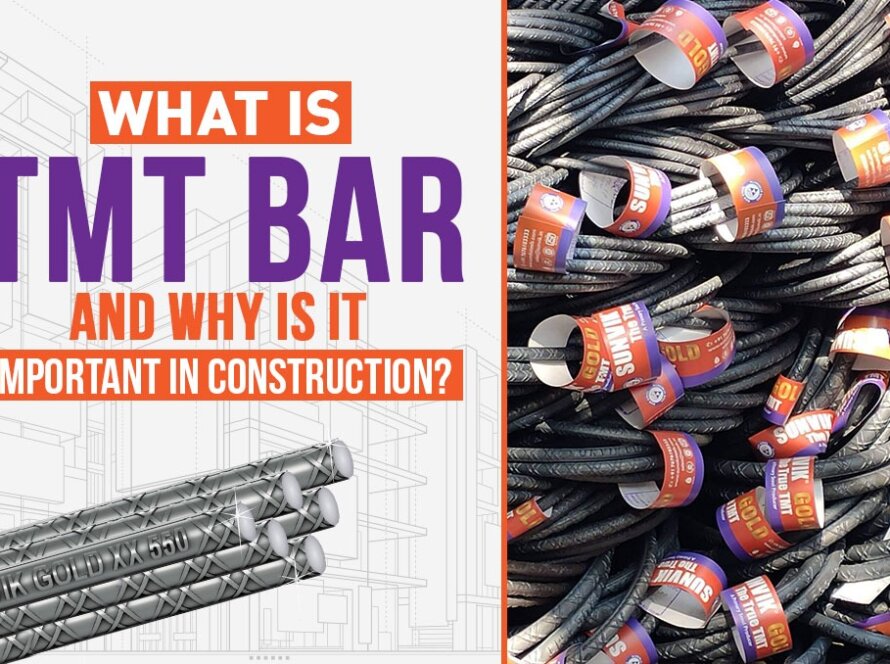
Role of Rib Pattern Design in TMT Bars
When we evaluate the strength of a building, we often discuss concrete grade, steel grade, structural drawings, and load-bearing capacity. However, one technical aspect that significantly influences structural performance—but is rarely discussed in detail—is the rib pattern design on TMT bars.
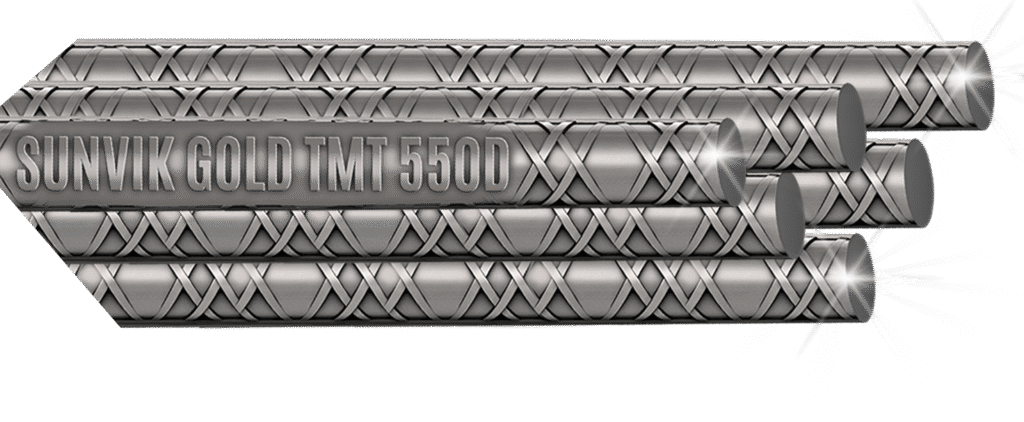
Those raised projections along the surface of TMT bars are not decorative elements. They are engineered features developed to enhance bond strength, anchorage, load transfer, ductility, and long-term durability of reinforced concrete structures.
In modern construction, especially in high-rise buildings, bridges, industrial structures, and seismic zones, rib pattern design plays a direct role in structural safety and performance. Let us explore this topic in depth.
Understanding TMT Bars and Surface Engineering
TMT (Thermo Mechanically Treated) bars are high-strength reinforcement bars manufactured through a controlled process of:
- Hot rolling
- Rapid quenching
- Self-tempering
- Atmospheric cooling
- Tri layer section of tmt bars
This process creates:
- A tough outer martensitic layer
- A ductile ferrite-pearlite core
While the internal metallurgical structure determines tensile strength and ductility, the external rib geometry determines bonding efficiency with concrete.
Reinforced concrete works on composite action—steel resists tensile stress, and concrete resists compressive stress. This composite behavior is effective only when proper bonding exists between the two materials. Rib pattern design is what ensures this bond is strong and reliable.
What Is Rib Pattern Design?
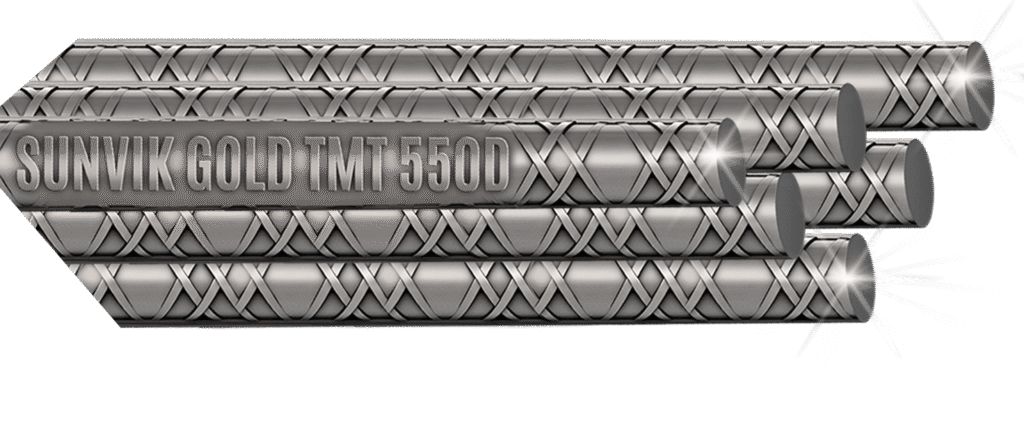
Rib pattern design refers to the arrangement, height, angle, spacing, and projected area of transverse and longitudinal ribs on the surface of TMT bars.
There are generally two types of ribs:
1. Longitudinal Ribs
These run parallel to the axis of the bar and assist in alignment and structural stability.
2. Transverse Ribs
These are inclined ribs placed at specific angles along the bar length. They are primarily responsible for mechanical interlocking with concrete.
The geometry of these ribs is not random. It is engineered according to structural standards to achieve optimal bonding performance.
Why Rib Pattern Design Is Critical in Reinforced Concrete
1. Mechanical Interlocking Mechanism
In plain mild steel bars, bonding depends only on:
- Adhesion
- Surface friction
However, in ribbed TMT bars, bonding includes a third mechanism:
- Mechanical interlocking
When concrete sets around ribbed steel, it locks into the grooves between ribs. This creates resistance against:
- Pull-out forces
- Shear stress
- Cyclic loading
The stronger the interlocking effect, the better the structural performance.
2. Bond Stress and Load Transfer Efficiency
Bond stress is the force per unit area that develops between steel and concrete. Rib pattern design directly influences bond stress values.
Higher bond strength means:
- Reduced slippage
- Efficient stress transfer
- Lower crack width
- Better structural integrity
Proper rib spacing ensures stress is distributed evenly along the bar rather than concentrating at a single point.
3. Anchorage and Development Length
Development length is the minimum length required for a bar to transfer stress safely into concrete.
A well-designed rib pattern reduces required development length because:
- Enhanced bonding improves anchorage
- Mechanical grip reduces slippage
- Force transfer becomes more efficient
This allows:
- Better structural detailing
- Optimized reinforcement placement
- Reduced congestion in beams and columns
4. Crack Control in Concrete Structures
Cracking is inevitable in reinforced concrete structures under tensile stress. However, the width and propagation of cracks must be controlled.
Ribbed TMT bars help in:
- Restricting crack widening
- Improving crack distribution
- Maintaining structural stiffness
Uniform rib geometry ensures micro-cracks remain controlled rather than turning into major structural weaknesses.
5. Seismic Resistance and Cyclic Performance
In earthquake-prone regions, structures undergo repeated cyclic loading. The reinforcement must:
- Maintain bond integrity
- Withstand reversal of stresses
- Resist fatigue failure
Rib pattern design ensures bars do not lose anchorage during vibrations. Strong bonding improves ductile behavior, which is essential for seismic resilience.
6. Structural Durability and Corrosion Resistance
Although rib patterns do not directly prevent corrosion, they indirectly contribute to durability by:
- Minimizing micro-voids between steel and concrete
- Reducing pathways for water penetration
- Maintaining tight steel-concrete contact
Better bonding reduces the chances of moisture accumulation around reinforcement, thereby increasing structural lifespan.
Key Technical Parameters of Rib Design
Rib Height
Rib height must be sufficient to provide mechanical grip but not excessive to obstruct concrete flow.
Rib Spacing
Proper spacing ensures uniform stress distribution along the bar length.
Rib Angle
Angled ribs provide resistance against axial pull-out forces and improve anchorage strength.
Projected Rib Area
Standards specify minimum projected rib area relative to the nominal bar surface. This ensures adequate bond strength.
Rib Inclination Pattern
Alternating rib directions enhance bonding symmetry and reduce directional slippage.
Precision in these parameters differentiates high-quality TMT bars from inconsistent or substandard products.
Manufacturing Process and Rib Formation
Rib patterns are formed during the hot rolling stage using specially designed grooved rollers.
The process involves:
- Heating billets to high temperatures
- Passing them through rolling mills
- Imprinting rib geometry using calibrated rollers
- Quenching to create hardened outer layer
- Self-tempering for core ductility
Advanced rolling mill technology ensures:
- Uniform rib height
- Consistent rib spacing
- Accurate geometric control
- Surface integrity
Any deviation during rolling can affect bond strength and structural performance.
Influence of Rib Pattern on Different Construction Applications
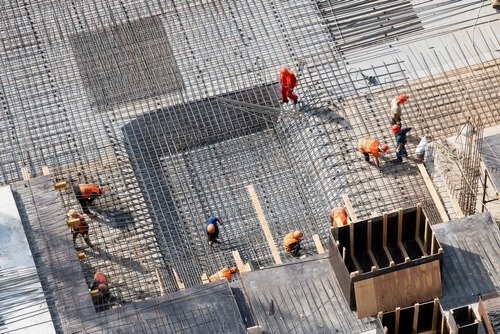
Residential Construction
Ensures better bonding in beams, slabs, and columns.
High-Rise Buildings
Improves load transfer in vertical reinforcement.
Bridges and Infrastructure
Enhances fatigue resistance under dynamic loading.
Industrial Structures
Supports heavy machinery loads and vibration resistance.
Rib geometry becomes even more critical in large-scale infrastructure projects where safety margins must be higher.
Common Issues with Poor Rib Design
Substandard rib patterns can lead to:
- Reduced bond strength
- Increased development length
- Early cracking
- Structural slippage
- Compromised seismic performance
Therefore, builders and contractors should not evaluate TMT bars based only on grade (Fe 500, Fe 550, etc.). Rib design precision is equally important.
Choosing Quality TMT Bars for Stronger Structures
A high-quality TMT bar combines:
- Strong metallurgical structure
- Precise rib geometry
- Consistent manufacturing control
- Compliance with standards
Manufacturers like Sunvik Steels Pvt Ltd focus on producing premium TMT bars with engineered rib patterns that enhance bonding strength, durability, and structural reliability.
Whether you are building residential homes, commercial complexes, or infrastructure projects, choosing reliable reinforcement makes a long-term difference in safety and performance.
To explore high-strength TMT bar solutions, visit https://sunviksteels.com/ and build with confidence using trusted steel reinforcement.
Frequently Asked Questions (FAQs)
1. What is the main purpose of ribs in TMT bars?
Ribs create mechanical interlocking between steel and concrete, improving bond strength and preventing slippage.
2. How does rib pattern affect bond stress?
Rib geometry increases surface friction and projected area, enhancing stress transfer efficiency.
3. Does rib height impact structural performance?
Yes, optimal rib height ensures strong bonding without affecting concrete flow.
4. Why are ribbed bars better than plain bars?
Ribbed bars provide superior anchorage, better load transfer, and improved crack control.
5. Can rib design influence development length?
Yes, better bonding reduces required development length.
6. Do rib patterns vary between manufacturers?
Yes, rib precision and geometry depend on rolling technology and quality control standards.
7. Are rib patterns important in earthquake zones?
Absolutely. Strong bonding ensures ductile behavior during seismic loading.
8. Does rib pattern affect corrosion resistance?
Indirectly, yes. Better bonding reduces moisture penetration pathways.
9. How are ribs formed during manufacturing?
Ribs are formed during hot rolling using grooved rollers.
10. Should contractors inspect rib consistency?
Yes, uniform rib pattern indicates quality manufacturing and reliable structural performance.
Conclusion
The rib pattern design in TMT bars is a fundamental engineering feature that significantly influences structural strength, bonding efficiency, and long-term durability. While steel grade determines tensile capacity, rib geometry ensures that this strength is effectively transferred to concrete.
In modern construction, where safety, longevity, and performance are critical, even small design elements like rib patterns play a major role.
Selecting high-quality TMT bars from trusted manufacturers ensures your structure stands strong for decades with superior bonding, reduced cracking, and enhanced safety.