


How to Choose the Right TMT Bars for House Construction
If you ask most homeowners what they spent time researching while building their house, you’ll hear about tiles, modular kitchens, paint shades, maybe even door handles. Steel rarely comes up in that conversation.
Which is a bit strange, because once the house is finished, everything you see is sitting on something you’ll never see again — the reinforcement inside the concrete.
On many sites, TMT bars are bought in a hurry. A contractor calls a dealer, asks for a rate, and the material arrives the next day. Work continues. No one really pauses to think if that choice will still hold up for many decades.
This blog isn’t going to overcomplicate things. It’s just a simple, practical way to think about choosing TMT bars so you don’t end up guessing.
Start With This Simple Question
Before grades, brands, or prices — ask this:
What kind of structure are you building?
A small single-floor house and a G+3 building don’t need the exact same approach. The loads are different. The stress points are different. Even the way steel behaves inside the structure matters more in taller buildings.
Most people skip this thinking and go straight to “which brand is best.” That’s not wrong, but it’s incomplete.
What TMT Bars Actually Do (in real terms)
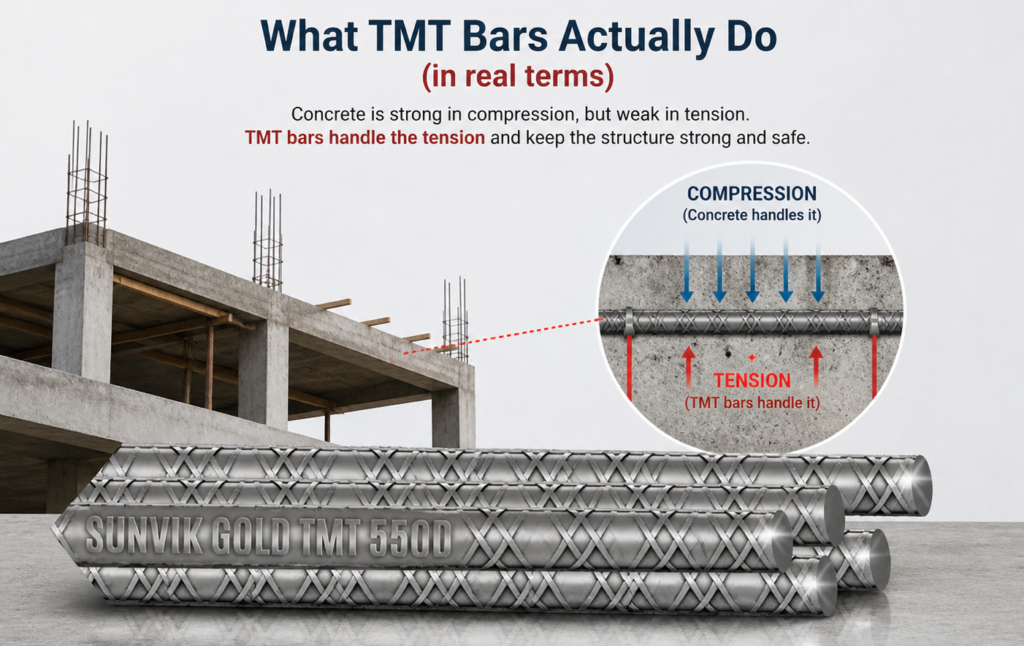
You already know they provide strength. But here’s how it plays out on site:
- Concrete handles compression (weight pushing down)
- Steel handles tension (pulling, bending, shifting forces)
Now imagine a slab during summer heat, then winter, then monsoon. There’s expansion, contraction, slight movement. It’s not dramatic, but it’s constant.
If the steel inside is too rigid or poorly made, it doesn’t adjust well. Over time, you start seeing:
- Hairline cracks
- Weak joints
- Damp patches near reinforcement zones
This is why people say “steel quality matters,” but don’t always explain how.
Grades — Don’t Overthink, But Don’t Ignore
You’ll mostly come across Fe 550 and Fe 550D.
A lot of buyers just pick whatever the contractor suggests. That’s fine if you trust them, but it helps to know the difference in simple terms:
- Fe 550: Standard choice for most residential houses
- Fe 550D: Slightly stronger, with better elongation (it can stretch a bit more before breaking)
For a normal house, Fe 550 works well. If you’re building an extra bit more load-intensive and want extra margin, Fe 550D is a safer bet.
What matters more than the number, honestly, is whether that grade is consistent across the material you receive.
The “Feel” of the Bar — Something Workers Notice First
If you spend even a few minutes watching steel being handled on site, you’ll notice something.
Some bars bend smoothly. Others feel a bit stiff or uneven.
Experienced workers pick up on this quickly. They may not explain it technically, but they’ll often say:
“Yeh steel thoda hard hai” or “yeh achha bend ho raha hai.”
That “feel” usually comes from how the bar was manufactured.
A good TMT bar:
- Bends without surface cracks
- Doesn’t feel brittle
- Maintains shape without snapping back awkwardly
It’s a small thing, but it tells you a lot.
Surface and Ribs — Not Just for Looks
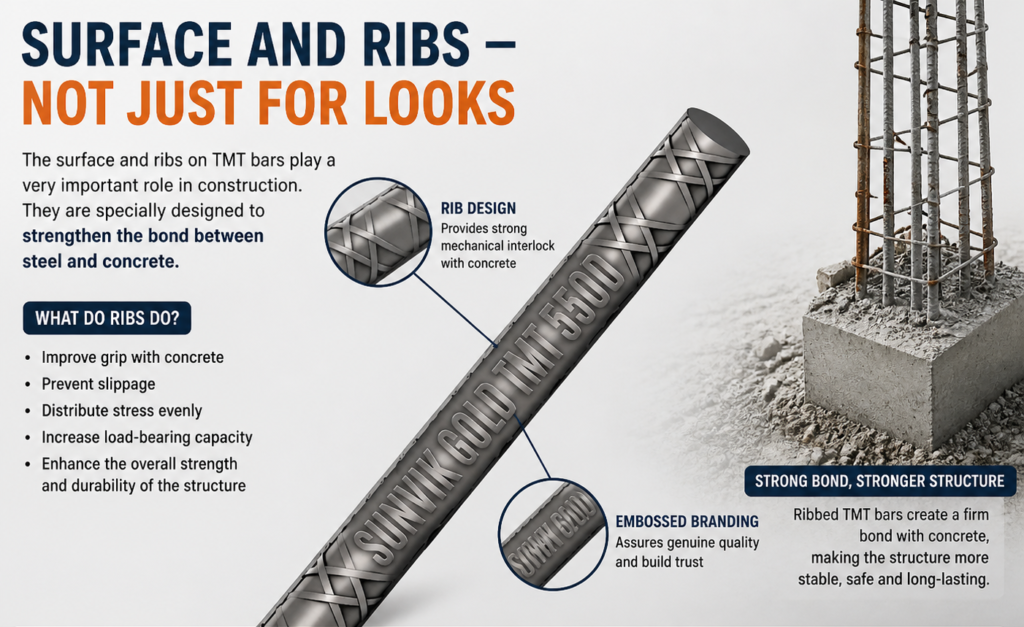
Those patterns on TMT bars aren’t decorative.
They help the concrete grip the steel. Without proper bonding, the steel can slip slightly inside the concrete under load. You won’t see it immediately, but over time it weakens the structure.
Better rib design means:
- Stronger bonding
- Less internal movement
- Better load distribution
You don’t need to measure anything here. Just make sure the ribs are clearly defined and consistent.
Rust — A Common but Ignored Problem
You’ll often see steel lying on site, exposed to rain.
A light layer of rust isn’t unusual and can be cleaned. But deep rusting is a different story.
What matters more is how resistant the steel is in the long run.
In places with:
- High humidity
- Coastal air
- Poor drainage
corrosion becomes a real issue over time.
That’s where better-quality TMT bars hold up longer. Not instantly visible, but important over years.
One Mistake That Happens More Than People Realize
Mixing brands.
It usually happens like this:
- Work starts with one brand
- That brand goes out of stock
- Another supplier sends a different one
- Work continues without much thought
On paper, both might be Fe 550. But manufacturing processes differ, and so does performance.
It’s always better to stick to one brand for the entire structure if possible.
Storage Matters (Even After Buying the Right Steel)
This part gets ignored completely.
Even good-quality TMT bars can be affected if:
- Left directly on soil
- Exposed to water for long periods
- Stacked improperly
Simple things help:
- Keep them slightly elevated
- Cover during heavy rain
- Avoid long storage before use
It’s basic site discipline, but it makes a difference.
Price — Where Most Decisions Go Wrong
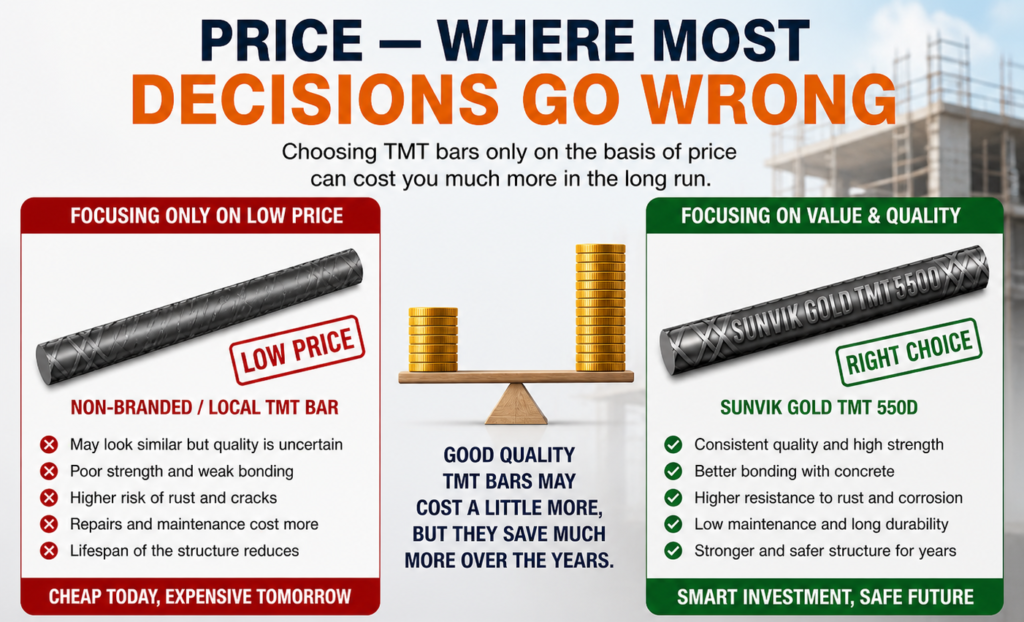
There’s always a temptation to save a bit here.
“Steel mein thoda adjust kar lo, baaki cheezon mein kharcha kar lenge.”
The problem is, steel is not where savings show immediately. The impact shows years later.
Also, the price difference between good and average steel is usually not huge in the overall project cost. But the long-term difference can be.
So instead of asking “which is cheapest,” it’s better to ask:
“Which one is reliable for the next 40-50 years?”
Choosing a Brand Without Overcomplicating It
You don’t need to compare 10 brands.
Just look for:
- Consistency in supply
- Proper manufacturing process
- Clear product specifications
- Availability in your area
For example, Sunvik Steels Pvt Ltd offers TMT bars along with other steel products, and focuses on maintaining uniform quality across batches. That consistency is often more useful on-site than just high claims.
If you want to understand their range or check what fits your project, you can go through their details here: https://sunviksteels.com/
A Small Real-Life Pattern
If you visit older houses in the same area, you’ll notice something interesting.
Two homes built around the same time:
- One looks almost unchanged
- The other shows cracks, repairs, patches
Many factors are involved, but steel quality is usually one of them.
It’s not something people think about while building. But later, it becomes obvious.
Final Thoughts
Choosing the right TMT bars doesn’t need a technical deep dive. It just needs a bit of awareness and a little patience during purchase.
You’re not buying something that will be replaced in a few years. Once it goes inside the structure, it stays there for decades.
So even if it takes a bit more time to decide, it’s worth it.
FAQs
Yes, for most residential houses it works well. If you want a more strength and flexibility, you can consider Fe 550D.
Check how it bends, look at the rib pattern, and buy from a manufacturer known for consistent supply.
Light rust can be cleaned, but heavily corroded bars should be avoided.
It’s better not to. Try to stick to one brand for uniform performance.
Not always, but extremely low-priced steel should be checked carefully. Reliability matters more than just cost.


