


Types of Mild Steel Nails
On most construction sites, there are a few things that are always lying around—cement bags, steel bars, wooden planks… and a box of nails.
Nobody really talks about nails much. They’re just there. You pick one, hammer it, and move on.
But if you’ve spent enough time on-site or even in a workshop, you start noticing small differences. Some nails go in smoothly. Some bend halfway. Some hold tight, while others loosen after a while.
That’s when you realise—not all nails are the same.
And when it comes to mild steel nails, there are quite a few types, each made for a slightly different kind of job.
What Exactly Are Mild Steel Nails?
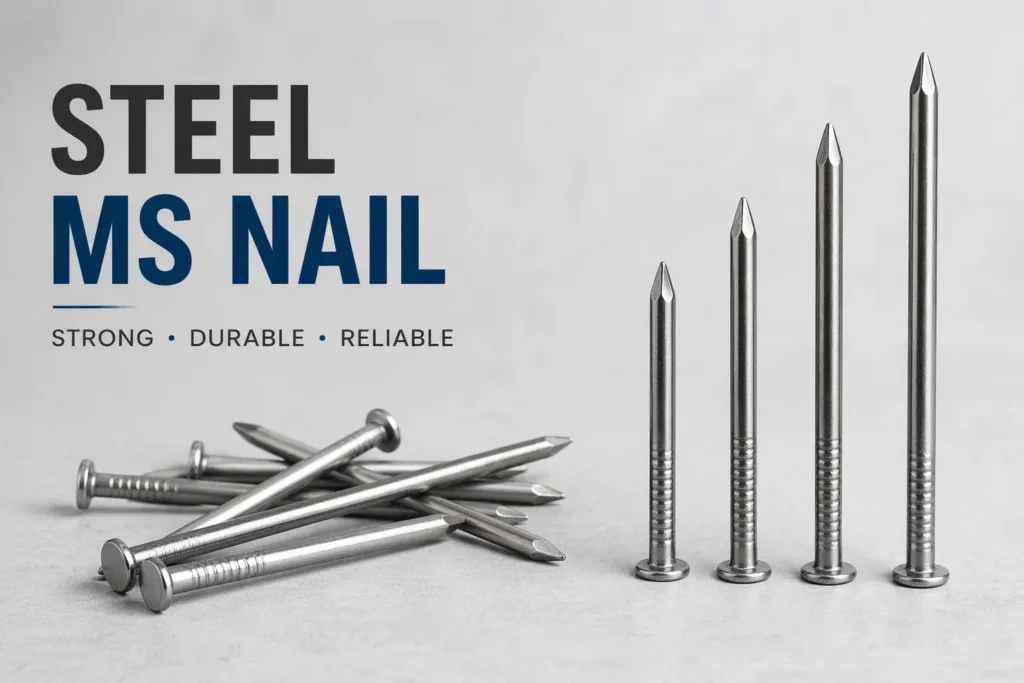
In simple terms, these are nails made from low carbon steel.
That’s why they’re not too brittle and not too hard either. They sit somewhere in between—strong enough for regular work, but still easy to hammer and shape.
This is also why they are so commonly used. You don’t need special tools or techniques. Just a hammer and a bit of experience.
Why Different Types Even Exist
At first, it might feel like overthinking.
A nail is a nail, right?
But try using a thin nail on a hard surface, or a small-head nail where grip is important—you’ll immediately see the problem.
Different types exist because:
- materials behave differently
- load requirements change
- finish matters in some work
- speed and ease also matter on-site
Once you start paying attention, it actually makes sense.
Common Types of Mild Steel Nails (From Real Use)
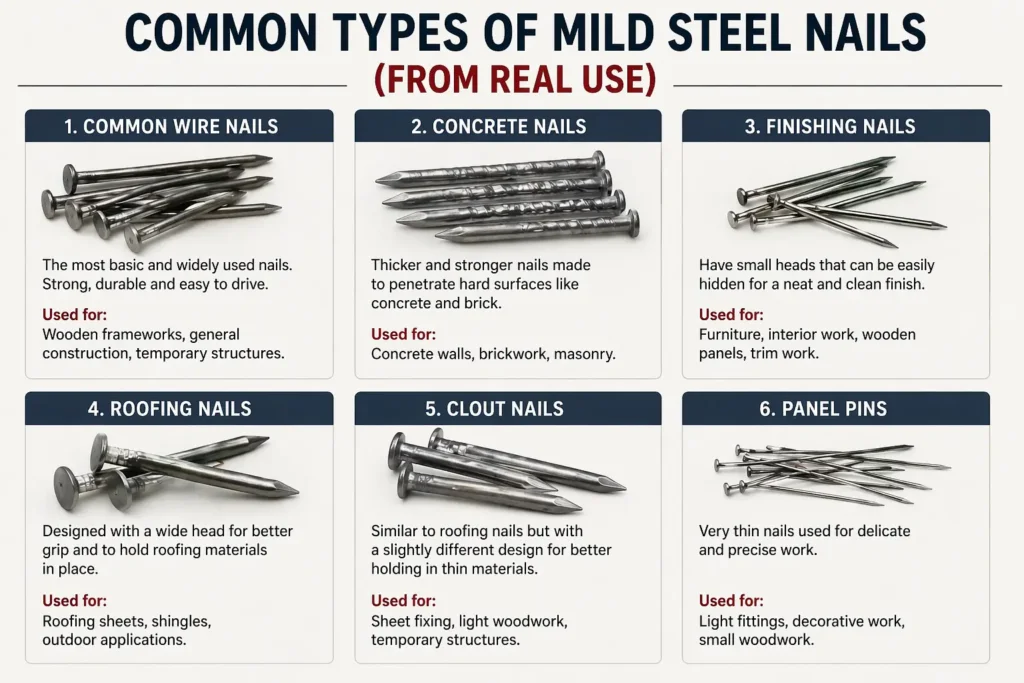
Let’s go through the ones you’ll most likely come across.
1. Common Wire Nails
These are the ones you’ll see the most.
If there’s a random box of nails on a site, chances are these are inside.
They’re simple:
- straight shank
- flat head
- decent grip
Used for:
- wooden frames
- temporary structures
- general fixing work
They’re not fancy, but they’re reliable for everyday use.
2. Concrete Nails
Now this is where things change.
If you try using a normal nail in concrete, it will bend before it even goes halfway.
Concrete nails are made tougher.
They are:
- thicker
- harder
- less flexible
Used for:
- concrete walls
- brick surfaces
You’ll notice they need more force to hammer in. Sometimes even pre-drilling helps.
3. Finishing Nails
These are used when the final look matters.
For example, in furniture or interior work, you don’t want nail heads sticking out.
So these nails:
- have very small heads
- can be hidden easily
Used in:
- wooden panels
- furniture
- trim work
They don’t hold as strongly as larger nails, but that’s not their purpose.
4. Roofing Nails
Roofing work needs a different kind of hold.
Wind, weather, and movement all affect it.
That’s why roofing nails come with:
- a wider head
- better grip on surface
Used for:
- roofing sheets
- shingles
The wide head prevents materials from slipping or tearing.
5. Clout Nails
These are somewhat similar to roofing nails but used more in lighter applications.
They help when you need:
- better surface hold
- support for thinner materials
You’ll often see them used in:
- sheet fixing
- light woodwork
6. Panel Pins
These are very thin and almost invisible once used.
They are not meant for strength.
Used in:
- small fittings
- decorative work
- light wooden tasks
If you’re doing detailed work, these come in handy.
What You Notice After Some Experience
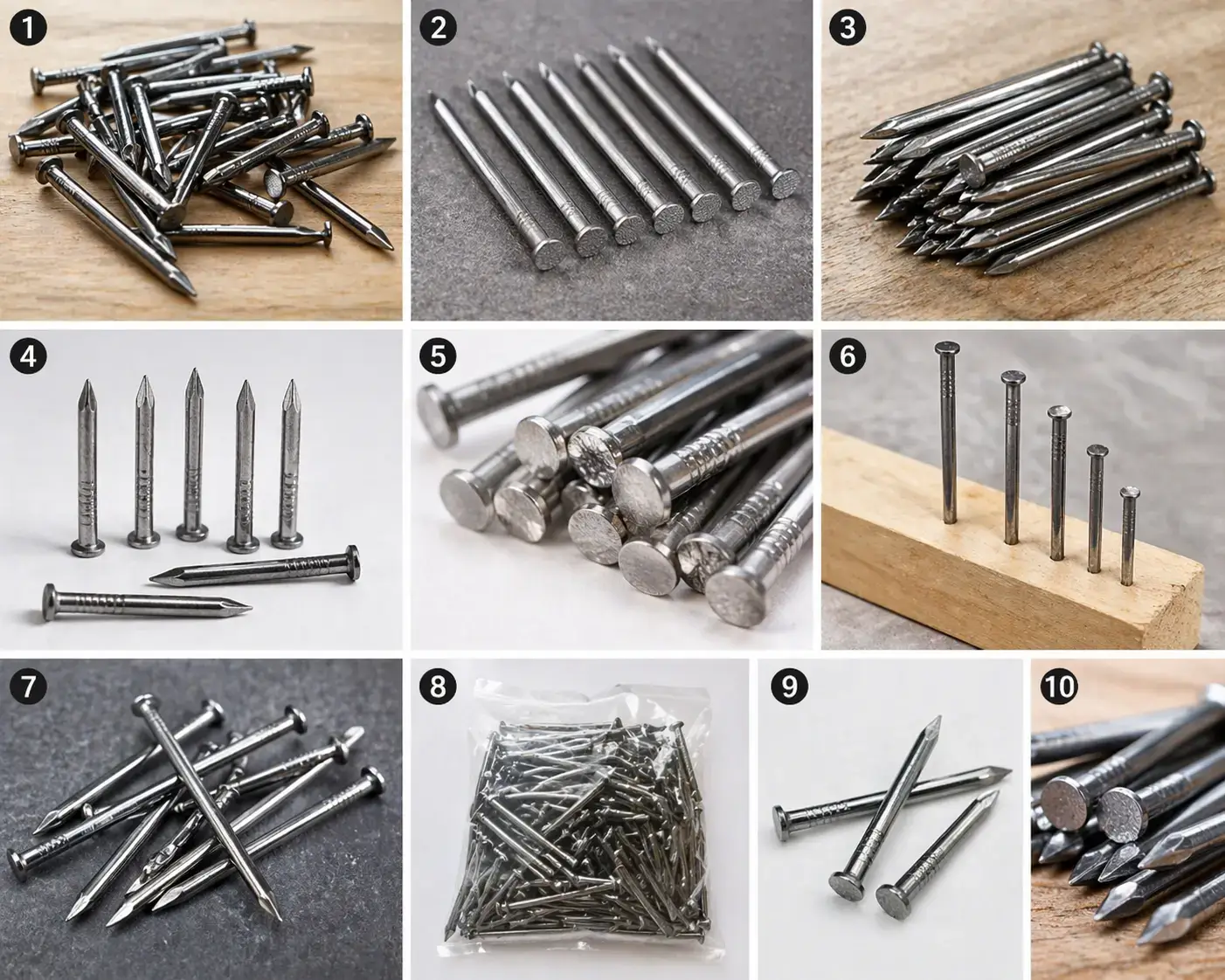
This is something that doesn’t come from reading—it comes from actually using them.
Over time, you start noticing things like:
- some nails bend too easily
- some go in smoothly without cracking wood
- some hold better even after days
And that usually comes down to quality.
Two nails might look exactly the same, but behave completely differently.
Where Mild Steel Nails Are Used (Real Scenarios)
They’re used almost everywhere, but mostly in:
- wooden framework setup
- shuttering work (temporary setups)
- fixing boards and panels
- roofing installation
- small repair jobs
In many cases, they’re not permanent solutions. But they make the work possible.
Something People Usually Ignore
Storage and handling.
It sounds small, but it matters.
If nails are:
- exposed to moisture
- stored in open areas
- mixed with rusted materials
they start losing quality.
You’ll notice:
- rust
- reduced strength
- harder hammering
Even good nails can perform badly if not stored properly.
A Quick Reality Check
Nails are important—but they are not what holds a building together.
They help in:
- fixing
- holding temporarily
- finishing work
But the actual strength of any structure comes from:
- concrete
- reinforcement steel
So while nails support the process, they’re not the backbone.
About Sunvik Steels Pvt Ltd
When it comes to everyday construction work, materials like MS nails play a small but very practical role. They are used across different stages—whether it’s fixing, holding, or supporting temporary structures on-site.
Sunvik Steels Pvt Ltd offers quality MS nails that are consistent in finish and performance, making day-to-day work smoother and more reliable.
While nails may not always get much attention, using the right quality makes a noticeable difference in how easily and efficiently the work gets done.
You can check more about their products here:
https://sunviksteels.com/
Final Thoughts
Mild steel nails are one of those things you don’t think much about—until something goes wrong.
Then you realise:
- the type matters
- the quality matters
- and even small choices affect the work
You don’t need to overcomplicate it.
Just understand the basics, use the right type for the right job, and avoid low-quality material.
That alone makes a noticeable difference.
FAQs
1. What are mild steel nails used for?
Mostly for general fixing, woodwork, and temporary construction work.
2. Are all nails the same?
No, different nails are made for different purposes.
3. Can I use normal nails on concrete?
No, they will bend. You need concrete nails.
4. Do mild steel nails rust?
Yes, especially if exposed to moisture.
5. Which nail is best for woodwork?
Common wire nails or finishing nails, depending on the work.
6. Are finishing nails strong?
They are not meant for heavy strength, mainly for appearance.
7. Why do some nails bend easily?
Usually due to lower quality or incorrect usage.
8. Can nails be reused?
Sometimes, but they may lose strength or shape.
9. Do nails affect structural strength?
No, structural strength depends on steel and concrete.
10. How to choose the right nail?
Based on material, purpose, and required strength.


